Version: current

Implementing a tricot experiment

Kauê de Sousa, Rachel Chase

Setting up experiments. For On-farm testing, best practices in planting and maintaining the plots. For consumer testing, best practices in handling the samples. Preparing the packages for distribution.

Farmer recruitment

Any farmer who wishes to participate can get involved in a tricot experiment. Recruiting as many motivated farmers as possible is key to the success of the project. The local field agents should help to identify and recruit farmers in their communities.

Hanging posters in agricultural shops, village halls or corner shops may also help to attract attention. You do not need to know the farmers before they participate.

However, farmers should be:

  • volunteers who are ready to commit time and effort to participation;
  • farmers who enjoy experimenting and trying out new methods;
  • both women and men, preferably at an even ratio.

A. Tricot is an iterative process This means that farmers ideally participate more than once in different experiments and across different seasons. When a tricot project starts and farmers participate for the first time, upfront project investments are required. The local field agents must be trained. Also, setting up and implementing the training workshops for participating farmers takes time. During their first cycle, farmers may have many questions and need assistance from local field agents. As the farmers will learn many things during each iteration of the process, and as they get to know only three randomly chosen technology options per cycle, we would encourage farmers to participate repeatedly. This way, first-time farmers can ask their more experienced farmer-colleagues when they have doubts, and the farmers get the chance to experiment with new sets of technology options with every cycle.

B. Local groups can carry out a joint trial Carrying out a group or joint trial makes the learning process easier and participation more fun. Any existing group, like farmers’ committees, credit cooperatives, or a religious group can receive a trial package and participate together. In this case, a ‘host’ farm is needed, where the technology options can be tested. The host farmer will be the contact person for the local field agent, while all activities – such as planting and making the trial observations – can be performed jointly by the group. In the following season, individual group members may want to plant a trial for themselves, building on the experiences they gained in the group trial. To enhance the participation of women farmers, it can be useful to establish ‘women’s research groups’, who would be in charge of a number of tricot plots.

Registration of farmers

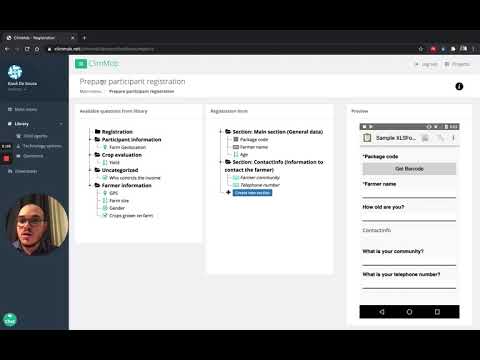
The ODK Collect app is used to register participating farmers. When the farmers receive their personal trial packages, they are registered by Field Agents using the project-specific registration form.‘Prepare farmer registration’ and will be available when the ODK Collect app is connected to the project on the ClimMob digital platform. The form should be downloaded to all field agents’ devices.

At a minimum, these basic data are required: • Trial package QR code • Name of the tester (participating farmer)

The trial package code uses an QR code generated by ClimMob as a unique package ID throughout the trial. The QR Code is generated once the technologies are defined and the randomization is set up. The project implementer prints the codes (available in the Downloads section) and pastes it into each package. Note: farmers should keep their package (QR) code for the duration of the project.

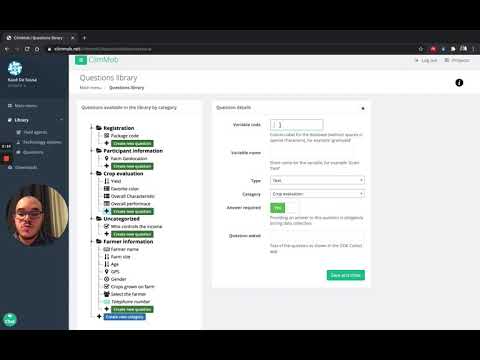
More in-depth information regarding household and farm characteristics can be collected during registration using the pre-developed RHoMIS survey (available on the ClimMob website).

Implementation