Download the Introduction chapter as a PDF
Introduction to the tricot approach
Jacob van Etten, Jonathan Steinke, Kauê de Sousa
Tricot (triadic comparisons of technologies, pronounced “try-cot”) is a citizen science approach for testing technology options in their use environments, originally conceived in 2011 (van Etten, 2011). The Oxford English Dictionary defines citizen science as “the collection and analysis of data relating to the natural world by members of the general public, typically as part of a collaborative project with professional scientists”. Different definitions are given by others, but our use of it is not far from this one. As a citizen science approach, tricot actively involves non-scientists in experimental data generation and interpretation. This follows a broader movement of applying citizen science and crowd sourcing methods in research on food and agriculture, providing a fresh lease of life to participatory agricultural research (Minet et al., 2017; Ryan et al., 2018; van de Gevel et al., 2020).
Tricot addresses important challenges in on-farm testing (de Sousa et al., 2024). In addition, the approach is increasingly used for areas closely related to on-farm testing of varieties, such as food product testing for sweetpotato implemented by CIP (Moyo et al., 2021) and gari/eba implemented by IITA (Emmanuel Alamu et al., 2023; Olaosebikan et al., 2023). Testing technologies in their use environments is important for external validity of experiments, the degree to which the findings have application outside of the experimental setting. To overcome common issues in user testing, the tricot approach streamlines the approach through digital support throughout the experimental cycle, simplifies the experimentation format to make user participation easy, and enhances data analysis by enriching it with data about the user context.
The method was first implemented and tested between 2013 and 2016 for on-farm testing of varieties, and an earlier article reported about methodological progress in this period (van Etten et al., 2019). Much of this work was part of the Seeds for Needs initiative, aiming at broadening the range of varietal diversity to farmers to adapt to climate change (Fadda et al., 2020). These projects were focused on cereals and grain legumes. Since then, the tricot approach has been used for other trials, by different organizations (including private sector) and for different applications (food products, fertilizers, etc.), and for clonal crops (cassava, sweetpotato, potato), vegetables, and a perennial crop (cacao).
Description of the tricot approach
Tricot enables many citizen scientists doing a small experiment while contributing to answering a larger question. Researchers and citizen science participants are supported throughout the experiment cycle by digital tools to design, execute, monitor and analyze the trials. As many citizen scientists contribute and do experiments in their typical use environments using their usual practices, it becomes possible to start to understand how variation in environments and practices affects the results. The trajectory from conceptualization of tricot in 2011 to its scaling phase in 2022 is described by de Sousa et al. (2024).
The particular way in which tricot works makes these steps possible. The following aspects are key to tricot:
-
The use of incomplete blocks of three items: makes the threshold of participation low in terms of farm size, and reduces resource needs and training required;
-
The use of ranking as the main way to report observations: facilitates digital data collection and makes it possible to evaluate an experiment with very little training and calibration;
-
The limited control of experimental conditions: following common local technology use practices to maximize external validity;
-
The use of a streamlined digital process from trial design to analysis: makes it manageable, executable with many participants, reduces errors and costs, and quickly delivers feedback to achieve high motivation and impact on subsequent decisions;
-
Early feedback of the results to the participants: provides ownership and stimulates engagement of participating “citizen scientists”.
Tricot builds on existing participatory research formats that have been used in the past, as documented by (van Etten et al., 2019). The novelty of the format is the combination of the different elements in a standardized, widely used approach supported by a corresponding digital platform, ClimMob (https://climmob.net). The platform is described in detail in Quirós et al. (2024) and throughout this eBook. ClimMob supports the user in designing a trial, randomizing the entries, creating electronic questionnaires, collecting the data, monitoring trial progress, and generating reports.
How is the tricot approach is used?
The tricot approach leverages citizen science to generate robust, scalable insights across diverse environments and user contexts. Here's how it integrates into different aspects of product use testing:
- On-farm testing
Farmers receive three randomly assigned technology options (e.g., seed varieties, fertilizers) and independently evaluate their performance under local conditions. No direct supervision is required, making it cost-effective and scalable, especially in remote areas. Data collection focuses on farmer-reported outcomes such as yield, resilience, and preference, linked to environmental metadata (e.g., soil, climate), socio-economic metadata (e.g., market preferences, household dynamics, management practices) and DNA metadata (de Sousa et al., 2021; Kang et al., 2025; van Etten et al., 2019; Voss et al., 2025).
- Consumer testing
Tricot integrates consumer preferences for end-use products (e.g., taste, cooking quality, shelf life). Farmers and end-users assess outputs from tested options (e.g., crops, processed goods) to ensure alignment with market demands. The approach helps bridge the gap between agricultural production and consumer needs by combining field performance with end-user satisfaction (Emmanuel Alamu et al., 2023; Olaosebikan et al., 2023).
- Concept testing
Tricot can be used to evaluate broader concepts, such as innovative farming practices, new varieties and agroforestry designs. Participants compare three alternatives in usability, practicality, or benefits, ensuring the development of context-specific solutions (Donovan et al., 2025). This iterative testing phase supports refining ideas before large-scale implementation.
- Scaling and adaptation
Tricot's simplicity allows broad implementation across geographies, crops, and technologies (de Sousa et al., 2024). The model is adaptable to low-resource settings, supporting smallholders while enabling private sector product testing. It also fosters inclusitivity, involving women, youth, and marginalized groups in the innovation process.
- Outcomes and impact
Enhances crop diversity and resilience by tailoring recommendations to local needs (Gotor et al., 2021). Speeds adoption rates by aligning product characteristics with farmer and consumer preferences (Occelli et al., 2024). Supports sustainable and climate-adaptive agriculture by integrating real-world testing with robust scientific analysis. In summary, the tricot approach is a dynamic, end-to-end solution for product use testing in agriculture, integrating farmer trials, consumer insights, and conceptual testing. It drives innovation by prioritizing user needs, ensuring product relevance, and enabling resilient and inclusive agricultural systems.
How the tricot approach works
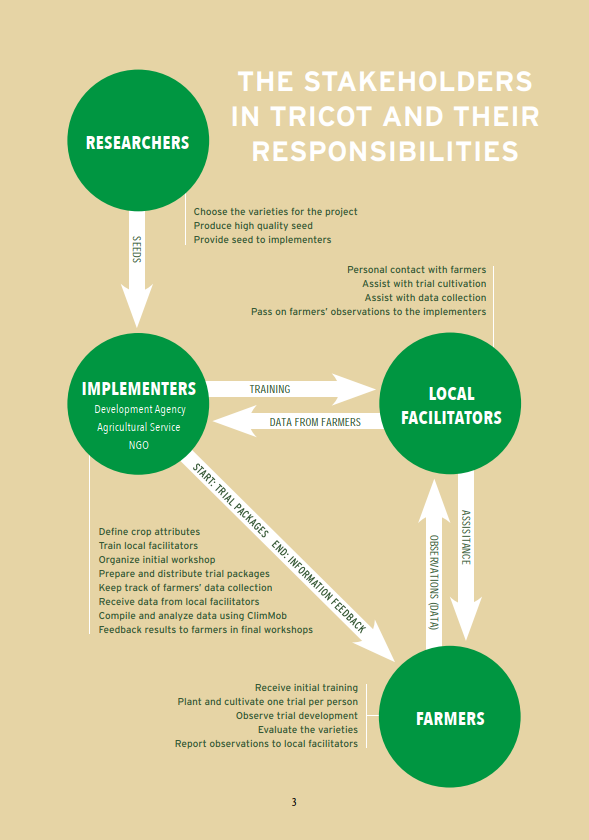
With the tricot method, large numbers of farmers carry out many small, simple trials on their own farms instead of a few big, complex trials conducted at research stations. The trial manager provides the participating farmers with material for the on-farm trials. The farmers provide observations from their trials to the agricultural research center, where the data from all mini-trials is aggregated and analyzed. The trial manager then feeds back the findings to the farmers.
With tricot, research centers can validate and disseminate new agricultural technologies in a participatory way, collaborating with a large number of farmers under diverse conditions. Large-scale tricot experiments, involving many farmers, generate excellent/reliable results about the performance of different technology options (such as different crop varieties or different fertilizer types) in different environments. Farmers evaluate the new technology options on their own farms and under real conditions.